E-Book
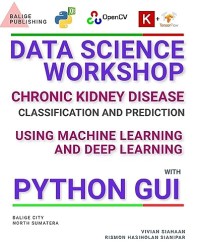
DATA SCIENCE WORKSHOP 2nd edition
In the captivating journey of our data science workshop, we embarked on the exploration of Chronic Kidney Disease classification and prediction. Our quest began with a thorough dive into data exploration, where we meticulously delved into the dataset's intricacies to unearth hidden patterns and insights. We analyzed the distribution of categorized features, unraveling the nuances that underlie chronic kidney disease.
Guided by the principles of machine learning, we embarked on the quest to build predictive models. With the aid of grid search, we fine-tuned our machine learning algorithms, optimizing their hyperparameters for peak performance. Each model, whether K-Nearest Neighbors, Decision Trees, Random Forests, Gradient Boosting, Naive Bayes, Extreme Gradient Boosting, Light Gradient Boosting, or Multi-Layer Perceptron, was meticulously trained and tested, paving the way for robust predictions.
The voyage into the realm of deep learning took us further, as we harnessed the power of Artificial Neural Networks (ANNs). By constructing intricate architectures, we designed ANNs to discern intricate patterns from the data. Leveraging the prowess of TensorFlow, we artfully crafted layers, each contributing to the ANN's comprehension of the underlying dynamics. This marked our initial foray into the world of deep learning.
Our expedition, however, did not conclude with ANNs. We ventured deeper into the abyss of deep learning, uncovering the potential of Long Short-Term Memory (LSTM) networks. These networks, attuned to sequential data, unraveled temporal dependencies within the dataset, fortifying our predictive capabilities.
Diving even further, we encountered Self-Organizing Maps (SOMs) and Restricted Boltzmann Machines (RBMs). These innovative models, rooted in unsupervised learning, unmasked underlying structures in the dataset. As our understanding of the data deepened, so did our repertoire of tools for prediction.
Autoencoders, our final frontier in deep learning, emerged as our champions in dimensionality reduction and feature learning. These unsupervised neural networks transformed complex data into compact, meaningful representations, guiding our predictive models with newfound efficiency.
To furnish a granular understanding of model behavior, we employed the classification report, which delineated precision, recall, and F1-Score for each class, providing a comprehensive snapshot of the model's predictive capacity across diverse categories. The confusion matrix emerged as a tangible visualization, detailing the interplay between true positives, true negatives, false positives, and false negatives. We also harnessed ROC and precision-recall curves to illuminate the dynamic interplay between true positive rate and false positive rate, vital when tackling imbalanced datasets. For regression tasks, MSE and its counterpart RMSE quantified the average squared differences between predictions and actual values, facilitating an insightful assessment of model fit. Further enhancing our toolkit, the R-squared (R2) score unveiled the extent to which the model explained variance in the dependent variable, offering a valuable gauge of overall performance. Collectively, this ensemble of metrics enabled us to make astute model decisions, optimize hyperparameters, and gauge the models' fitness for accurate disease prognosis in a clinical context.
Amidst this whirlwind of data exploration and model construction, our GUI using PyQt emerged as a beacon of user-friendly interaction. Through its intuitive interface, users navigated seamlessly between model selection, training, and prediction. Our GUI encapsulated the intricacies of our journey, bridging the gap between data science and user experience.
Availability
Detail Information
- Series Title
-
CERVICAL CANCER CLASSIFICATION AND PREDICTION USING MACHINE LEARNING AND DEEP LEARNING WITH PYTHON GUI
- Call Number
-
616.99 Sia d
- Publisher
- North Sumatera : BALIGE., 2023
- Collation
-
-
- Language
-
English
- ISBN/ISSN
-
-
- Classification
-
616.99
- Content Type
-
E-Book
- Media Type
-
-
- Carrier Type
-
-
- Edition
-
2nd edition
- Subject(s)
-
-
- Specific Detail Info
-
-
- Statement of Responsibility
-
Vivian Siahaan
Other version/related
No other version available
File Attachment
Comments
You must be logged in to post a comment
 Computer Science, Information & General Works
 Philosophy & Psychology
 Religion
 Social Sciences
 Language
 Pure Science
 Applied Sciences
 Art & Recreation
 Literature
 History & Geography